Showing posts with label Donald Trump. Show all posts

Wednesday, June 7, 2017

KSU students, faculty share opinions, debate effects of Trump travel orders

Photo by Thomas Hartwell

KENNESAW, Ga. – Seven days after his inauguration, President Donald Trump signed an unprecedented executive order temporarily restricting, and in some cases altogether halting, travel from seven Muslim-majority countries into the U.S. Proponents of the order hailed it as a necessary security measure to prevent terror attacks on the U.S., while critics called it discriminatory and a blatant ban of travelers, visa-holders and refugees, based on religion.

In the days following the executive order, protesters took to streets, capitals and airport terminals in cities all around the country. But some of the most outspoken protesters were found on college campuses. In only three days, an online petition entitled “Academics Against Immigration Executive Order” amassed more than 7,000 signatures from U.S. academic faculty members, as reported by the U.S. News and World Report. The petition now has more than 43,000 total signatures.

President Trump’s initial executive order was struck down by a federal judge in Seattle, and the 9th U.S. Circuit Court of Appeals upheld the ruling. The president has since amended his executive order and again been blocked by federal judges in Hawaii and Maryland.

While the legitimacy of the newest executive order remains under review, the protests and vocal disagreement with President Trump’s policies and rhetoric have continued on college campuses nationwide. Kajol Patel is a junior at Kennesaw State University and serves on the International Student Association’s executive board as the international festival coordinator. She says, whether the revised executive order is blocked or not, the attempted policy placement is not one of a welcoming country.

Students gather to work, eat lunch and chat in KSU’s Global Village, a hangout spot coordinated and
sponsored by the International Student Association. Photo by Thomas Hartwell

“You know the terms, like, ‘melting pot,’ ‘the salad bowl.’ The U.S. is made up of so many different types of people with different backgrounds,” said Patel. “So, I see (the ban) more as discrimination. It’s kind of grouping everyone – like just because you’re Muslim, you’re automatically considered a terrorist, or you’re bad or have bad intentions. It’s wrongly grouping people.”

KSU freshman, Brian Dickey, disagrees. The orders aren’t discrimination, he says. They’re security measures paramount to national security. Global terrorism is the issue in question, says Dickey, and there’s no solution without a decision.

“Terrorism is kind of a tricky egg to crack,” said Dickey. “But you’ve got to kind of identify the source, and I don’t think we’re going to get anywhere if we just kind of dance around it. I think we need to take some sort of hard action, and I think (the order is) a step in the right direction.”

He pauses, smiles and emphasizes, “I don’t know if it’s necessarily the right option, but I think it should be given a chance.”

Dickey is a self-proclaimed “die-hard Trump supporter,” and he is one of many who say the president isn’t given a fair chance to explain himself or prove his policies’ effectiveness. Dickey says the campaign rhetoric may have been shocking to a lot of people, but now is the time to judge by President Trump’s actions.

“I personally believe people are jumping to conclusions with (Trump) in office,” said Dickey. “People are not giving him a clear-minded chance. When it comes to politics, the truth is – in almost every case-scenario – no one’s ever just said, ‘You’re right,’ when they’re arguing politically. Especially when it comes to balancing relations – in terms of discrimination – and public safety, there’s a very gray, gray area.”

But Patel says, even ignoring the “gray area” of public safety versus discrimination, there’s a concern of a growing acceptance of a culture of discrimination, taught by the president’s words and actions.

“(Trump) is the face of America right now. He’s all over the news, he’s all over the place, and he’s preaching acceptance (of discrimination), and that’s all people are seeing on the news,” said Patel. “If that’s all they’re shown, then I guess that’s what people will believe is OK.”

The comments from both sides of the argument, says Dr. Joseph Bock, director of KSU’s School of Conflict Management, Peacebuilding and Development (program site), have often been blown out of proportion as a result of a very divided state of nation over this issue.

“There is a lot of fear in our society,” said Bock. “So this (debate) is a result in a politically charged environment.”

The U.S. and its citizens, regardless of what side of the debate people find themselves on, says Bock, are still the accepting country and people that they always have been.

“I do think people are standing up in solidarity with Muslims here in the US,” said Bock.

But what is most important in the debate is the mutual respect on both sides – a respect that Bock says is common at KSU.

“I think we have a diversity of views at KSU, and that is one reason it is a special place,” said Bock. “We are not ideological conformists. We respect the human dignity of everyone, provided they affirm the inherent dignity in others.”

Patel and Dickey also acknowledge the need for respect and understand that, especially with an issue like this one, sometimes people will just have to agree to disagree.

“I don’t think we’re going to get to a place where everyone’s happy, but as an American, I believe America comes first, before anything else.”

While she may not see eye to eye with Dickey, Patel says, while the issue of national security is, of course, important, so is being the “land of opportunity.” But, if nothing else, she says, there is one good thing that’s come from all of this:

“People are freely talking about (discrimination) now. People are really voicing their opinions,” said Patel. “And maybe it is because of the ban – where it was so shocking that people have a need to voice their opinion – but, in a lot of cases, people are expressing how important they think immigrants are.”


Tuesday, January 24, 2017

The World View, Episode 5: Brexit and the Potential Opportunities for Travel

In this episode, I discuss the repercussions and potential travel opportunities of the exit of Britain from the EU (also known as Brexit). Interviews with BBC Southeast reporter Natalie Graham, travel experts and soundbytes from the BBC SE financial podcast "Money Box."

Saturday, November 12, 2016

Thursday, May 26, 2016

Trump's the GOP nominee -- Now what?

By THOMAS HARTWELL

Let's talk about something very near and dear to my heart, or rather, my amygdalae -- the fear-conjuring portions of the human brain: A Trump nomination. Initially the thought of a Trump nomination gave me a sense of relief. "Well, if Trump is nominated, at least November will be triumphed by someone who, you know, isn't Trump." Now, though, I've begun to worry. Trump wasn't supposed to make it through the first couple months of a candidacy, and yet, here he is -- the GOP nominee. I've said "never" and been proven wrong in respect to Trump's campaign too many times to find any comfort in a statement that he could "never" win in November.


Not only has Trump now clinched the GOP nomination with more than the required 1,237 delegates bound to him, but several polls also show a narrowing margin between he and Hillary Clinton, a candidate who has only a slightly lower unfavorable rating than Mr. Trump. Amid an ongoing investigation into Clinton's use of a private email server during her time as Secretary of State and in a time of considerable public disdain and mistrust for the political establishment, Clinton's campaign seems to have more work cut out than previously thought.

Months ago, polls showed match ups in which Hillary Clinton won in landslide fashion over Donald Trump in November 2016, but those polls have recently been showing a spread within the margin of error and in some cases even with Trump edging Clinton out. "How could this possibly happen?!" I hear some of you out there shouting. Clinton supporters and Anti-Trumpsters alike neglected to take into account early on the effectiveness of Trump's personal attacks and empty promises on the masses. As expected, Trump has turned his attention solely to the presumptive Democratic nominee and begun a tirade based around a question of Clinton's character, coining a popular use for his campaign: "Crooked Hillary." There shouldn't be much surprise surrounding the narrowing of hypothetical match ups between the presumptive nominees. Polls conducted months before a general election and while other candidates remain in the race mean very little when taking into account all of the discoveries and events that could and would take place between then and an actual general election match up.

The best weapon that the Clinton campaign has left is a focus on her experience in politics and Trump's lack of experience. But even Clinton's experience in and around political office hasn't been able to save her from an unfavorable rating hovering anywhere between 50-60 percent -- she chose a bad time to be considered untrustworthy. Also, the Clinton campaign's earlier jabs at Trump's possible nomination -- "Really, folks? America's going to nominate Trump?" -- didn't resonate with anyone except the already Anti-Trump, and the "Trump's a joke" shtick can't, with any credibility, be used anymore.

Sanders is also causing the Clinton campaign some headache. While 66 percent of Sanders supporters say they would back Clinton if she were nominated, there have been reports of up to 20 percent of those "feeling the Bern" that would back Trump over Clinton. Clinton's supporters are also much more willing to support Bernie (88 percent) should he receive the nomination, prompting an even louder cry from many for a November Bernie bid (article here). But, sorry to all those out there feeling the Bern, the best possible thing that could happen to the Clinton campaign, and that could happen for the Never Trump movement, right now would be the suspension of Sanders' bid for the Democratic nomination paired with a Clinton endorsement from the Bern himself. Sanders should be careful not to alienate Clinton supporters if he really wants to defeat Trump and if he really is not going anywhere until the bitter end in July.

There have been calls for a third option, and I have to say, in a presidential campaign season that has already been filled with surprises, I think that hypothetical candidate could steal away quite a few votes, granted they distanced themselves enough from both candidates and still chose either a right or left lean.

Tuesday, March 29, 2016

Republican Party Cage Match: Contested Convention

By THOMAS HARTWELL

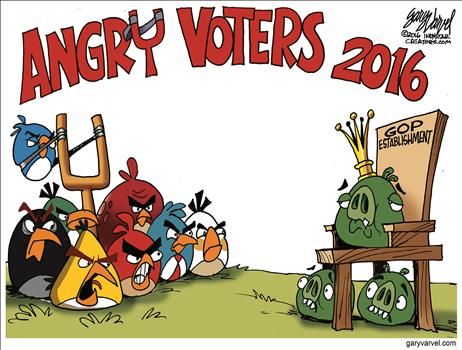
As the race for the Republican nomination continues on its wrecking-ball-esque path of destruction and embarrassment, the possibility of a contested convention has begun to lean to the side of probability.

Political Cartoons by Gary Varvel
Political cartoon by Gary Varvel. From http://townhall.com/political-cartoons/2016/01/18
In the midst of the president's historic trip to Cuba, the FBI's breaking into the San Bernadino shooter's phone, the veto of Georgia's "religious exemption" bill and several terrorist attacks around the globe, the Republicans have chosen to continue the blood bath that is repeated stabs at each other's personal lives, track records and even wives' track records. Republican voters and Independents alike have voiced increasing frustration with the "play the player, not the ball" tactics, and Democrats have to be looking on rubbing their hands together in wait for November.

Even the, thus far, unshakable Trump supporter base has begun to show signs of plateau or even decline. As has been recorded since the beginning of the campaign season, Trump's unfavorable rating continues to best his favorable, but it has grown even further. His is now the highest ever recorded, according to a Gallup poll. This has further excited establishment Republicans and the Never Trump movement on the left and the right in their crusade to force the nomination to a contested convention.

From the Associated Press
Trump currently has 739 delegates to Cruz's 465. While the difference at first glance may seem like a lot, it's simply not, and Cruz has a trick up his sleeve. With the same organization and "ground game" that won Cruz several Republican caucuses across the country, the campaign is collecting extra "unpledged" delegates, a tactic over which Trump has threatened suit -- so unlike him. Trump's campaign has since picked up the strategy as part of a plan to block the contested convention. Cruz's ground game has the potential to close the gap on Trump, though, and with diminishing support in a race becoming increasingly future-sighted, Cruz might be able to make a case for himself at a contested convention.

BUT... would the establishment rather put Cruz, a third party not already running or even Kasich up for nomination? Here's the simplest answer I can give: I dunno -- not right now at least. While Cruz is the other front-runner and the establishment really doesn't like Trump, they're not a huge fan of Cruz either. The Texas senator doesn't have many friends in Congress and tends not to play well with others. He's a conservative with "give me conservatism or give me death" tendencies, which would usually sound great for Republicans, but since he's really in this for himself and not necessarily the party, the fact that he doesn't always like to go with status quo turns a lot of his colleagues off. I think there's a good chance of a Romney-like nomination out of a contested convention, but what I think should happen is a Kasich nomination.


Kasich is a moderate Republican who, thus far, has been flying pretty low-profile and staying out of the Republican Hunger Games. While he started out as a "nobody," voters have been taking notice. His moderate-ness could be the best weapon in a fight against Hillary in November, and his mix of establishment history and "just a regular guy" platform could serve him well in a general election, too. Interestingly, national polls often show Kasich and sometimes Cruz -- but not Trump -- beating Hillary in a general election in November, but at this point, take those polls with a grain of salt -- it's still pretty early.

Oh, and hey, Democrat voters, while you're probably sitting back watching this Republican debacle as a satire, you might start thinking about the internal conflict that may arise between a Trump nomination, which would likely end in a Clinton victory but is still downright terrifying, or a nominee who isn't Trump, which could mean a Democrat's demise.

Wednesday, March 23, 2016

Framing the presidential race

By THOMAS HARTWELL

The presidential race in any context is a media frenzy, but this race has been unlike any before it in many ways. As with any story, the media make choices as to how to approach the stories surrounding the presidential race, and there are four commonly used "frames" of presentation, all of which have been used to cover the year's campaigns.

Horse Race:


Horse race journalism in the political spectrum is the presentation of information as a contest or comparison of, in this case, presidential candidates. There's been a lot of talk about a possible convention contest for the Republican nomination this campaign season, and that has opened the door for A LOT of horse race journalism. With a race this close between Trump and Cruz and a candidate pulling delegates away from the two front-runners, many outlets are taking the opportunity to present some "who will win the sprint to 1,237?" stories. There has been some in regard to the Democrats' race as well, but with a race on the left seemingly more and more decidedly won by Hillary, there have been more stories about the change that Sanders' campaign has brought to politics than "who will win?"
From the Associated Press
Conflict:

Horse race and conflict presentation of the Republican race have gone hand-in-hand this campaign season. As the race has continued and candidates have dropped out, there has been more opportunity for conflict-frame journalism. For instance, this CNN article incorporates elements of the delegate race, but describes the race for the nomination between Trump and Cruz as a "duel." A search for stories about Trump on CNN and other news outlets provides a look at the presentation of Trump's campaign strategy: conflict frame and a "Trump vs..." mentality. 

From cnn.com search

Issues:

Candidates of the same party and especially opposite parties LOVE to slam each other on policy issues -- the presidential race produces plenty of these opportunities. While most attacks come on an opponent's stance on ongoing issues, current events also play a part. For example, Trump and Cruz chose to slam President Obama on immigration regulations and international terrorism in response to terrorist attacks in Brussels, Tuesday. Stories written on the issues provide voters and onlookers with the ability -- hopefully objectively, but we all know, not so much -- to make decisions based on those issues. Trump has also generated lots of attention and media spotlight for himself by making large and outrageous issue claims. He's actually winning in the presidential race on lots of the "important issues," because he has so much coverage out there on his policy on those issues.

From msnbc.com
Candidate Attributes:

Another frame of media coverage dominated by Donald Trump and, some may argue, Bernie Sanders. Trump and Sanders' revolutionary approach to U.S. politics has changed the race for good, and a lot of that focuses on their personal attributes. Plenty of stories have focused on Trump's deficiencies, outlining why he couldn't, shouldn't or wouldn't be President of the United States.

From toptens.com
This article even outlines ten reasons why Donald Trump should not be the next president, citing his past words, actions, claims, etc.

Friday, March 11, 2016

Republican party aims to trump Trump as candidate furthers his delegate lead

By THOMAS HARTWELL

The 2016 presidential campaign has been one that has, in many ways, strayed from the normal workings of U.S. elections, with the season’s rhetoric centered around the anger and distrust of a “corrupt Washington.” While both sides have seen revolutionary political strategies and several broken ballot records, the Republican party’s election has undeniably been the more colorful of the two, and Donald Trump has captured voters’ attention. The Republican race to the general election is narrowing, and the Trump campaign seems to be rallying the needed public support to face the Democrats in November.

“The Trump phenomenon – no one saw this coming. No one really understands why it’s happening – what’s going on – but I’ve got some ideas,” said political expert Kerwin Swint.

Swint is an author, speaker and professor of political science at Kennesaw State University. He has run campaigns, written books and his work has appeared in several national and international media outlets. Swint said that the “Trump phenomenon” as well as this campaign season’s obviously splintered GOP is something that has been in the cards for a while and has the potential to have lasting effects.

“What’s going on in the Republican party is a real revolution,” said Swint. “It is serious, it is dramatic, it is significant and it’s going to have long-term consequences.”

While there are plenty of voters out there who have voiced their discontent with Trump, more surprisingly, said Swint, is the amount of resistance Trump is receiving from the, so-called, establishment Republicans. The establishment fears that a Trump nomination means a Clinton victory, but it goes beyond that.

“The other part of their thinking … is, ‘Good Lord, he might win,’ which might be worse,” said Swint. “President Trump would pay no attention or very little attention to the establishment.”

Swint also said that a number of Republicans would rather see Clinton win the general election than Trump – a party line-crossing that has not been seen in decades.

Trump has appealed, most abundantly, to white, blue-collar workers who are tired of Washington and who are willing to cross party lines to vote an “outsider” into the Oval Office. His ability to pick up Independent votes has given him an edge in the delegate count, said Swint, but the damage that he and others have been doing to the GOP this season has forced some voters to display their unhappiness in other ways.

Zac Carr, a 25-year-old Cobb County voter said his primary vote was cast as a symbol of his own unhappiness with the candidates this campaign season.

“I voted for Rand Paul despite the fact that he is no longer running,” said Carr. “I asked for a non-partisan ballet because I, like George Washington, believe that the two-party system only polarizes our country. I wanted to do my part by showing that I believe non-partisan is preferred over Republican or Democrat.”

Carr said that the “nastiness” in the Republican race forced his hand and initiated his Independent vote.

Lott Middlemas, a Florida voter and international relations and Chinese double major at the University of South Carolina, agreed that the GOP race has been ugly, but said that its dirty tactics might be good for the number of voters in a general election.

“I think that voter turnout on both sides will increase noticeably for both parties as a result of the inflammatory politics of the Republican party during this election cycle,” said Middlemas. “The Republicans have been talking for years about expanding their base of support by appealing to minorities, but I don't think they'll see that as being necessary anymore since they've managed to draw out many more white voters than usual without having to soften their stances on economic and social issues that are often important to minority voters.”

The Democrats, said Middlemas, will turnout in larger numbers simply because of their fear of a Trump presidency and Clinton, he said, will beat Trump handily.

Not so fast, says Swint. A Clinton win isn’t such a sure-fire thing in a head-to-head.

There are people assuming that Trump wouldn’t have a chance in a general election against Hillary Clinton. I’m not necessarily in agreement with that,” he said. “One of the strengths of Trump is that he’s put together a pretty broad coalition … It’s certainly not a slam dunk [for Clinton].”

It is his ability to appeal to groups of varying demographics and political opinion that potentially makes Trump dangerous, said Swint.

Yet another scenario in the Republican race is a nomination by a convention. Trump leads by about 100 delegates with 460, but he does have to get through a still very present Ted Cruz, and some wonder if the other Republican candidates may be able to pull enough delegates away from Trump to prevent his receiving a majority (1,237 delegates) and force the party to the convention. In this scenario, said Swint, the Republican leadership runs the risk, should they nominate someone other than Trump, of losing grip on their party.

“I think if they do take it away from [Trump] at the convention, I think he absolutely will run independent,” said Swint. “And I think at that point, he would be real interested in just wrecking the party for the Republicans.”

A non-Trump convention nominee would not only anger Republican voters, said Swint, but it would also cause “wheeling and dealing” between presidential candidates, state governments and others – precisely the kind of Washington antics voters are tired of.

According to Middlemas, though, Republican voters don’t need to worry about a convention.

“Super Tuesday cemented Donald Trump's supremacy in this race,” he said. “Sen. Cruz might be able to win a few more states, but Trump will certainly have a majority of delegates by the time the Republican national convention rolls around.”

Whether or not Trump has solidified his nomination remains to be seen, but polls with only Trump and Clinton’s name on them have begun to show up. Current CNN polls show either Democrat defeating Trump in November, but November is still miles down the road, said Swint.

“The general election [polls] right now are meaningless,” said Swint. “The election’s months and months away. We’re going to have coalitions, we’re going to have world events, we’re going to have economic developments that are going to affect that.”

All we can do now, said Swint, is wait and watch.


Wednesday, March 2, 2016

Who won the debate? Texas

By THOMAS HARTWELL

Thursday's GOP debate was both the most technical and most embarrassing debate of the 2016 Republican race for president. All of the candidates got more into the small details of specific issues (except Trump of course), but if you didn't have the patience or the resolve to wade through the sea of shouting and contorting of faces on the CNN stage, I wouldn't blame you for turning off the TV.

The largest takeaway from the debate was that Trump's downfalls can, in fact, be exposed. Rubio was especially successful in getting under Trump's skin and showing that the reality TV star isn't invincible, but Cruz and even the moderators exposed him a bit too.

RUBIO:
Previously, Republican presidential candidates have seemingly been afraid to attack Trump personally or aggressively. Rubio came to the latest debate prepared to do just that, and it seemed he was on a united front with Ted Cruz (they even shook hands at the end of the debate, looking pretty pleased with themselves).

Rubio attacked Trump relentlessly on use of Polish immigrant work in his early business and real estate endeavors, to which Trump -- visibly annoyed -- responded, "Yeah, 38 years ago," prompting one of the night's most memorable quotes from Rubio: "I guess there's a statute of limitations on lies." Rubio also attacked Trump on the allegations and lawsuits surrounding his "fake school," Trump University. Trump responded to the attacks saying, "I won most of those law suits."  Any time Rubio was able to get a solid punch in, which was pretty often, the crowd went absolutely nuts, proving to me that there are still some sane voters who want just as badly as I do to see Trump fall. Rubio also did well to expose, with some help from Cruz and (probably indirectly) the moderators, that Trump tends to simply repeat general claims -- "It'll be great," "It's gonna be huge," "We're going to win," "There will be many plans" -- over and over instead of getting into the how or why. The best part of all of Rubio's attacks?: He challenged audience members to Google everything he was claiming about Trump -- and it works, for the most part.

Rubio didn't just focus on Trump, though. He defended attacks on his policies and accusations well, remained composed the whole night and eloquently spoke on a range of topics -- most notably to me, when he was questioned on his possible change of stance on Obama's DACA executive order. Healthcare, military presence in the Middle East and the Supreme Court justice appointment were also hot-buttons which Rubio handled impressively. I have to say, I was betting on Rubio from the beginning, but he surprised me on that stage. He made Trump look like a fool, he was aggressive, he joked and genuinely looked like he might have even been enjoying himself. A much-needed strong performance before Super Tuesday. 10/10.

TRUMP:
I've never rated Trump on a debate performance before, and some of you may be thinking, "He HATES Trump -- his evaluation won't be reliable." Well, you might be right. BUT Trump royally stunk it up on that stage, and it was pretty obvious. He was sandwiched between the other two "front-runners," (I use quotations because Trump is up 30 percent nationally on the next closest candidate) and they relentlessly slammed him the whole night. Trump was visibly flustered when he was forced into providing specific answers, or asked to. Most memorably, was when Dana Bash prodded Trump on the specifics of the plan he would use to "replace ObamaCare." After Trump had repeated "their will be many plans," three or four times, Bash almost yelled "Can you be more specific, sir?" Trump dodged the specifics with a comment something like, "That's it."

In a moment of irony that actually made me laugh out loud, Trump also condemned former president of Mexico, Vicente Fox, for dropping an F-Bomb on TV in regards to Trump's claims that Mexico would pay for a border wall to be built on the U.S.'s southern border. Trump's condemnation of Fox's comments came only weeks after Trump repeated a rally attendee's criticism of Cruz, calling the fellow Republican candidate a pu*** with many, many cameras rolling. Mr. Trump, those who live in glass houses should not cast stones.

Overall, a terrible performance for Trump that may well have hurt him going into Super Tuesday... not too badly, of course. Somehow, Trump still took any opportunity he could to pat himself on the back, which his supporters always seem to love. He did better toward the end of the debate, when Rubio and Cruz let up a bit, but he was simply exposed by his lack of presidential ability or applicable experience. 3/10.

CRUZ:
Cruz did well on the stage, but was out-shadowed by Rubio. Cruz was well-spoken, and he looked presidential (I guess), but for me it comes down to Cruz being a little too theatrical. He worked well with Rubio on attacking Trump, and he spoke eloquently about Scalia's death and replacement. One of his best sound bytes from the night was on a Cruz-appointed Supreme Court justice, who, according to Cruz would, "vigorously defend the bill of rights for my children and for yours."

I liked his approach to the whole night, which to me seemed to be "fly under the radar, be fairly polite and take second on Super Tuesday." Cruz didn't viciously attack anyone, he walked softly and he even did things like ask for, not scream about, talking time on ObamaCare. During his talking time, he did take an opportunity to attack Trump, in a pretty civilized manner, on his stance on socialized medicine and a specific heathcare plan.

There's not too much to say about Cruz's performance -- it wasn't overwhelming -- but I give him a pat on the back for just that. For not attempting to be a spectacle, 7/10.

KASICH:
I can't say I was surprised by Kasich's strong performance, but I think many people were. Kasich presented many of his ideas clearly and without any real negativity. He kept his word on running a positive campaign in regards to the other candidates even saying at one point, "[Let's] move beyond what they think. I'm going to tell you what I think." I applaud him for sticking in this race to, if nothing else, show American voters that there are still some wholesome candidates available.

Kasich is a pretty moderate Republican, except on abortion, and he tried to show all sides of that onstage. He told the audience about his pathway to legalization plan, citing George H.W. Bush and Reagan (good move), he outlined his ability to negotiate with Democrats and Republicans alike and, most progressively for a Republican, he told America, "the court has ruled, and I've moved on," in response to June's Federal gay marriage law. In one of his best moments, Kasich also made a down-to-Earth jab at one of America's current healthcare issues: "It's easier to interpret the Dead Sea scrolls than to interpret your hospital bill."

Kasich was a realist and a man of integrity on the debate stage, and I genuinely wish he had done better from the beginning of his campaign. Although I won't say he won the debate, it's only because of the kind of race that is happening in the GOP this campaign season. Maybe if he'd been running in a less cut-throat season, I could give the win to him (I wish I could now). From a policy and integrity standpoint, though, 9/10.

CARSON:
What is there to say about Carson? He is no longer running for president; he is performing a publicity stunt. Maybe he's trying to sell books (there you go Carson, there's a plug), maybe he's trying to make friends -- I don't know, but his utter silence on the campaign trail paired with his claim to "stay in it until the end" tells me that he's got some personal crusading he feels he needs to do.

In the debate, Carson had next to no questions thrown to him and even when he did, he answered them with three or four breaths between words and no energy. He answered questions abstractly, at one point saying that if he were to appoint a Supreme Court justice, he would do so by looking at the "fruit salad of their life" and not just one issue. In his best moment of the night, Carson, out of his neglected corner of the stage said, "Can someone attack me, please?" to attempt to reel in some extra talking time. In effect, he was the comedic relief for the tension between the three front-runners.

Carson did do just a couple things that keep him from getting a 0/10 from me: The first was that he cited his personal relationship with Justice Scalia.The second, and the one issue Carson was obviously passionate about, talking passed the bell and saying "Let me just finish. I don't get to talk a lot," was healthcare. The moderators seemed to allow him to talk until he was finished out of sheer pity. Overall, Carson lost this debate and has been ruled out, whether he stays in the race until the end or not. 2/10.

Friday, February 12, 2016

The New Hampshire effect

From New Hampshire public radio

By THOMAS HARTWELL

More records were broken Tuesday when the presidential candidates made their way to New Hampshire. While the Democrat's voter record was not broken, they contributed to the overall high voter turnout of 538,094, edging out the 2008 total voter turnout by around 11,000 ballots cast. The Republican voter turnout shattered previous records; 284, 120 voters cast ballots -- an increase of nearly 12,000 on the Republican side alone over the previous record-setting election (248,475).

There were a number of surprises in New Hampshire. Most shocking to me was Kasich's taking second place and receiving almost 16 percent of the Republican vote. Kasich came off of a debate performance where he looked more comfortable than previously and, apparently, where he impressed potential voters. I was surprised to see this large of a jump in his numbers, even while refusing to use negative ads against the other candidates -- a tactic which has proven very successful in New Hampshire in the past. Kasich needed this revitalization to his campaign after a not-so-strong debate performance on January 28 and a sheer beat down in the Iowa caucuses.

The amount of votes that Trump received was staggering to me, too. I knew going in that he was likely to win New Hampshire, as up to 34 percent of New Hampshire voters register as Independent and are, therefore, more likely to vote away from the "politician choices." What I was not prepared for was Trump's capturing of more than a third of New Hampshire (35 percent). Trump received 10 delegates to the next nearest candidate's four, so it was quite a victory for him... *sigh*

More surprises: Rubio dropped into fifth place, below Bush, who previously received only 3 percent of the vote in Iowa. Bush, like Kasich, desperately needed this attention from voters, but unlike Kasich, has remained extremely positive about his campaign -- easy to do when you have the amount of financial support he does, I guess. Rubio hasn't been doing so hot lately. He's been called "robotic" and "too rehearsed" after, in a couple cases, he has repeated almost exactly the same words several times in speeches. Rubio said it himself, he didn't do well when it mattered leading up to New Hampshire. Cruz did well to fly under the radar and focus his energy on South Carolina, amid some accusations of illegal campaign activity, taking third. I expect him to win there, as he has captured the evangelical vote for the most part. Christie and Fiorina did not receive enough support to justify continuing their campaigns, and as expected suspended them in the following days. If Carson has another performance like that of the 2 percent he earned in New Hampshire, he could be next.

In short, the Republicans' race could turn into a 2-person one. If Cruz does as well as many expect in South Carolina, he and the Trumpster could simply be too far out in front to catch.

As far as the Democratic vote goes... well, what'd I tell you? Bernie received a whopping 60 percent of the vote to Hillary's 38. This is due, mostly, to the state's large number of Independents (Bernie is registered Independent as a Vermont senator). Bernie received 15 delegates to Hillary's 9, but the two are tied going forward, as six out of eight of the "super delegates" have declared for Clinton. I expect that, in South Carolina, Sanders will not be able to overcome the large discrepancy in the African-American vote and will lose, potentially big, to Clinton.

Tuesday, February 2, 2016

Campaign narratives and candidate success


By THOMAS HARTWELL

A narrative not only makes for a more interesting story and, in turn, campaign season, but also can win a candidate a state, or even a general election. There have been more than a few surprising narratives driving the candidates' campaigns already this season, and I'm sure you wouldn't be surprised to hear me say that I will, again, be mentioning the Trump (I'm sorry, but as one of my professors once said, "He's the gift that keeps on giving"). The other not-so-surprising choice for a narrative-rich campaigner, I think, is easily Sanders.

I'll start with Trump and just get it out of the way.

Image result for trump not a politician

Trump has capitalized on two things: fear and frustration with Washington. Trump has been unapologetically blunt, crass and, at times, down-right rude. He can get away with this, and even continue to climb in the polls, because his narrative is that he is new -- he's a successful business man, not a politician, and he swears to use his hard bargaining, his CEO know-how and his tell-it-like-it-is-edness to bring his enemy to their knees and to "Make America great again." How, you ask? "Well, first things first, let's get me elected." People go for that. Partly because of Trump's story telling -- "I'm a successful business man who, like you, is fed up with Washington" -- and partly because his followers just want to see what his specific plans are finally.

Image result for sanders political revolution

Sanders tells a similar story of being fed up, but his story is a little more history and policy-based. Sanders tells us that he has been in politics since the '70s, building trust with listeners. He, like Trump, acknowledges the calls for change, but addresses the change with more specific answers that might be harder for some followers to process than a general, "It's gonna be HUGE." His largest success, though has been embodying the "little guy" who takes on the enormous establishment that is lobby groups and Super PACs. Distrust of cookie-cutter politicians makes Washington the antagonist in both of these candidates' cases and, of course, makes themselves the protagonist.

Sunday, January 31, 2016

Who won the debate?


Image result for GOP debate jan 28

By THOMAS HARTWELL

Thursday's debate harbored one of the first true opportunities for Republican presidential candidates to voice their stances on debated issues, sans Trump, after his decision to boycott. I think it important to mention that Fox's moderators and the candidates themselves, for the most part, did a good job of not mentioning Trump -- thank you, Fox. The network also broke new ground by teaming up with Google for the sake of analytics. The debate included stats and graphics showing the top search results and increased percentage of certain keywords on Google during the airing of the debate.

As we all know, of all the candidates on stage, Cruz was the leader going into Thursday's airing. The debate opened with a quick mention of Trump by Megyn Kelly, the moderator with whom Trump had "beef." Let's all take a moment to address "the elephant not in the room," said Kelly. Shortly thereafter, Cruz opened by calling "everyone on this stage... stupid, fat and ugly." He did well to hold his composure and his punchline to let what he had said stun viewers before concluding, "Now that we've gotten the Donald Trump portion out of the way..." (see the video here).

Claims of "winners" of the Iowa debate are scattered throughout the Internet, and every candidate's official Twitter page claims "so-and-so won the debate, so here's a discount on so-and-so merchandise." That being said, here's my take on each candidate's strong points as well as who won the debate -- I'll understand if you take it with a grain of salt, and no discounts... sorry.

TED CRUZ:

Cruz did just okay in Thursday's debate. He was attacked on changes of stance and policy quite a bit, as expected, but handled himself well, for the most part. Cruz did well to give the conservative audience what they wanted to hear as far as his healthcare plan saying, should he be elected to office, he would "repeal every word of ObamaCare." His discussion of immigration was smart, too; he cited his collaboration with Iowa's own Rep. Steve King for the brainstorming of the plan. His strongest point in the night, and the one that seemed to score him the most points with the crowd, was his promise to rebuild the military and "utterly crush" the Islamic State, a point he revisited in his closing statements. The election boils down to one question, he said, who do you trust to defend America?

What he didn't seem to have enough of Thursday night was confidence. His stance on ethanol subsidies had been one of much attention in Iowa -- many farmers are unhappy with the idea of no more subsidies -- and he was given a chance to clarify. While I believe he clarified the "why," I still don't know how much Iowan farmers like the idea of giving up the extra cash on their already pretty "cash-bringing" crop. He participated in a rather heated skirmish with moderator Chris Wallace, which didn't really go his way, made some jokes that didn't really seem to connect with the audience and was even booed once. At times he looked panicked and was all-around, just outshone. Overall, Ted, 6/10.

BEN CARSON:

While Carson was quite relevant at the start of the 2016 campaign, his popularity has waned vastly. It was Carson's religious basis and stories of his road to salvation that won many conservatives over early on, but as his campaign road has become more and more rocky, including the recent death of one of his volunteers, his spotlight and his support have dwindled.

His night on the debate stage seemed to speak to his difficult few weeks. Carson did not receive many direct questions, challenges or other opportunities to speak. When he was asked questions, they seemed, in my opinion, more challenging to answer than the other candidates'. He did, however, touch on a couple of popular conservative notions, which I will applaud him for: the need for less political correctness and the importance of powerful military action. His strongest point in the debate came toward the end, when he expressed America's need for military exercises all around Russia in response to Putin's aggressive tendencies. For your push for a bigger military and your patience with lack of talking time, Carson, 5/10.

JOHN KASICH:

Kasich seemed the most wholesome of the bunch Thursday night. He slung no ill words and seemed to have no ill will toward any of the other candidates, but that may have been his problem. Kasich hasn't really been aggressive enough this campaign season -- I suppose that comes with never having been a front-runner. For what it's worth, though, I believe his level head and his patience for a debate that didn't seem to welcome him was refreshing, and I think he surprised some people -- not nearly enough, but some.

Kasich didn't get to talk much either, but when he did, he spoke with confidence. His high points were a little moderate-sounding -- maybe that's why he's not hitting it too big with the conservatives. One of the best quotes of the night, I think, was his: "The mentally ill and drug addicted of this country have been stepped on for too long." He also scored some extra points with a call to action to the leaders of Flint, Michigan. All-around, your demeanor and holistic approach to Thursday's debate gets you a 5/10, Kasich.

RAND PAUL:

Is it just me, or are even Republicans leaning a little more to the middle these days? Rand Paul rallied quite a bit of talk with his many calls for racial equality and justice reform. He was calm, cool, collected and very well-spoken and well-prepared. He was first to go on the offense, attacking Ted Cruz on his voting against the "Audit the Fed Bill," which called for more transparency in the Federal Reserve's monetary policy. Paul also pointed out the much larger percentage of young African-American males in prison versus young white males for similar crimes, citing many of the country's hot spots for racial cases against the state over the past decade. While he struggled to answer the question of abortion in a way that satisfied both the typical conservative response, "pro-life in all cases," and what opinion I think is his own, (more pro-choice leaning), I think this was his best debate performance, and I think he'll see a slight rise in his poll numbers. For your confidence, your sticking to your own beliefs and your call for equality and justice reform, Paul, 7/10.

CHRIS CHRISTIE:

Christie didn't win, but he scored lots of points in my book with his use of humor (the points are imaginary, they don't really count for anything). He poked fun at the other candidates, at Donald Trump, at times, himself and even seemed to stand smugly at the podium. His main focus was letting the crowd know that he, and only he, could and would beat Hillary and that terrorism was the number one threat to Americans. He fended off the occasional, "Well, what about the bridge thing?" from the other candidates and closed with a promise of "crushing ISIS," a common theme of the night. His best moment, though, was when he was asked if he could name one thing the government did right now that it shouldn't do at all. He stood at the podium leaning heavily to one side on his elbow, he paused and said, "Yes... You want one?" The crowd loved it. His example, funding of Planned Parenthood, also scored him some points with the pro-lifers.

Christie didn't impress me with his answer to a question about racial profiling, though. He stumbled, stuttered and came up with an answer that sounded a bit like, "well it just isn't" when asked whether calling the authorities on "suspicious-acting Muslims" was an example of profiling. So, his humor couldn't totally save him, but I would say Christie gave the viewers a good time and did well to represent himself as a candidate -- so, Christie, 7/10 for you.

JEB(!) BUSH:

Jeb has been called low-energy, a loser and a nobody (most of these by Trump), he's had to settle for an endorsement from only his mother and his numbers continue to drop -- nationally he's at about 2% -- but Thursday night, he came prepared. I wish more of you out there liked him, but anyway, this isn't about that.

Bush was friendly when he should have been, aggressive when appropriate and worked in just the right amount of humor, even saying at one point, "I actually miss Donald Trump." Bush called for better care for veterans, laid out his immigration plan and addressed and offered a solution to Islamic extremism without playing into the fear-based "ban all Muslims" stance, for which more than a few have been calling. His highlights were his suggestion of focus on "Islamic terrorism" instead of "all Muslim-Americans" and his stance, though he had to defend a change over the years, on immigrants' path to citizenship. Maybe it's because he knows he's out of the race at this point, maybe it's because he has a fool's hope, but it seemed nothing could faze Jeb on that stage. Though I don't think his poll numbers will climb, I believe Bush was one of the winners of Thursday's debate. 9/10, Jeb.


MARCO RUBIO:

What can I say? Rubio surprised me. There's been a lot of talk about Rubio's looks, his charisma, his charm and his age (even though he's 44, only a year younger than Ted Cruz), and how all those things could work to his advantage in his campaign if he just really turned them on -- well, he turned them on. Rubio came out swinging, Thursday. He was aggressive, confident, consistent and fearless in his responses. He was quick to "expose the lies" in the other candidates' attacks on his policies, something many other candidates seemed to forget they could do, and in many cases, he turned the question of consistency on his attackers. The majority of his policy strengths for the night came on the topic of religion and the military (I would say, the two smartest choices for a conservative crowd). But one of the strongest quotes of the night came from him too: "Hillary doesn't want to run against me, but I can't wait to run against her."

Thursday night showcased a Rubio the likes of which voters have never seen. I would say Rubio was easily the other winner of the debate, and with a front-runner spot still sort of in reach for him, I wouldn't be surprised if his campaign caught some wind. Good job Rubio, 9/10.