Showing posts with label Ted Cruz. Show all posts

Thursday, April 14, 2016

Confirmation bias in the media: Show me, tell me

By THOMAS HARTWELL

We, as humans, believe that we are inherently correct and seek out information that agrees with our thinking. How does this apply to our daily thinking or our consumption of products, services, and news?


Confirmation bias, or the interpreting of evidence or information in regards to existing beliefs, has been addressed often in the discussion of the presentation of news. Most believe that there should be no biases in news reporting, and journalists are taught to stay completely objective in the presentation of hard news. While, in a perfect world, consumers of news could watch/read news presented completely objectively and make educated decisions based on what they read, we do not live in a perfect world. News organizations have to incorporate what sells into the presentation of their stories. There is also a consideration of gatekeepers who run the media organizations. While the goal should always be objective reporting, people have a tendency to have strong opinions on political issues, which many times manifest themselves in subtle biases in reporting.

When we explore confirmation bias in the larger media outlets, we often encounter a widely-accepted thought pattern: "CNN and MSNBC are liberal, Fox is conservative." While this is now considered the norm, the media outlets themselves would never come out and admit to it. The media outlets, therefore, must disguise their biases as "just another way of reporting."

Let's look at Fox and MSNBC's reporting of the same story. A racially insensitive joke was told at a charity dinner recently, and both outlets wrote a story on it. Keeping in mind that Fox is considered conservative and MSNBC liberal, there is a subtle difference in the reporting in a couple ways:

Image and story from foxnews.com
Image and story from msnbc.com
1. The headlines: In Fox's case, the headline reads that both Mayor De Blasio and Hillary Clinton take part in the joke and draw criticism. If we consider Fox's possible confirmation bias, it would make sense that they would want to frame Hillary in this way. Whereas, in MSNBC's case, only De Blasio takes part in the joke, and even then it's presented as "coming at a bad time" rather than being "racially-tinged."

2. The visuals: Fox shows Clinton and De Blasio laughing and seemingly celebrating with the headline "racially-tinged joke" hovering above. It seems to be framed as the two enjoying the insensitive comment. MSNBC instead shows Clinton off to the side looking on as the joke is made. This way, she seems to not take part in the joke making. Clinton also is even standing next to the African-American gentleman, further separating herself from the insensitivity.

Images, as we've already seen, can speak a thousand words in reporting, and often do. The images we see can impact our impression of the candidate depicted. For these examples, I'll choose a picture of Ted Cruz from CNN and one from Fox.

Image result for cnn presidential race cruz
Image from cnn.com
Image result for cnn presidential race
Image from foxnews.com
In these cases, the presentation of Ted Cruz is considered in the photos chosen to be published on the sites. CNN's picture choice is less than flattering, while Fox's looks like a campaign flier.

While minds won't necessarily be changed by only images or word choice, the presentation of information or images can alter the way that people think about a subject. Objective news reporting and an educated public would be preferable to what is widely accepted as a biased news environment, but in order to inform the public, the public must want to be informed. If it takes subtle biases (even no-so-subtle ones) to inform them, then so be it -- I'll take the news with a grain of salt.


Tuesday, March 29, 2016

Republican Party Cage Match: Contested Convention

By THOMAS HARTWELL

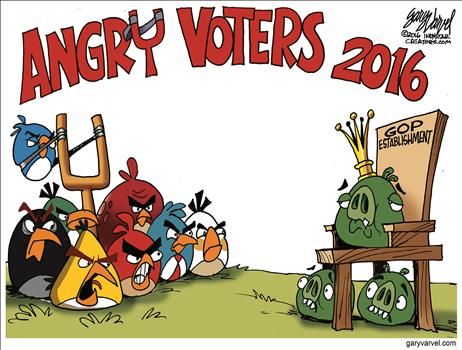
As the race for the Republican nomination continues on its wrecking-ball-esque path of destruction and embarrassment, the possibility of a contested convention has begun to lean to the side of probability.

Political Cartoons by Gary Varvel
Political cartoon by Gary Varvel. From http://townhall.com/political-cartoons/2016/01/18
In the midst of the president's historic trip to Cuba, the FBI's breaking into the San Bernadino shooter's phone, the veto of Georgia's "religious exemption" bill and several terrorist attacks around the globe, the Republicans have chosen to continue the blood bath that is repeated stabs at each other's personal lives, track records and even wives' track records. Republican voters and Independents alike have voiced increasing frustration with the "play the player, not the ball" tactics, and Democrats have to be looking on rubbing their hands together in wait for November.

Even the, thus far, unshakable Trump supporter base has begun to show signs of plateau or even decline. As has been recorded since the beginning of the campaign season, Trump's unfavorable rating continues to best his favorable, but it has grown even further. His is now the highest ever recorded, according to a Gallup poll. This has further excited establishment Republicans and the Never Trump movement on the left and the right in their crusade to force the nomination to a contested convention.

From the Associated Press
Trump currently has 739 delegates to Cruz's 465. While the difference at first glance may seem like a lot, it's simply not, and Cruz has a trick up his sleeve. With the same organization and "ground game" that won Cruz several Republican caucuses across the country, the campaign is collecting extra "unpledged" delegates, a tactic over which Trump has threatened suit -- so unlike him. Trump's campaign has since picked up the strategy as part of a plan to block the contested convention. Cruz's ground game has the potential to close the gap on Trump, though, and with diminishing support in a race becoming increasingly future-sighted, Cruz might be able to make a case for himself at a contested convention.

BUT... would the establishment rather put Cruz, a third party not already running or even Kasich up for nomination? Here's the simplest answer I can give: I dunno -- not right now at least. While Cruz is the other front-runner and the establishment really doesn't like Trump, they're not a huge fan of Cruz either. The Texas senator doesn't have many friends in Congress and tends not to play well with others. He's a conservative with "give me conservatism or give me death" tendencies, which would usually sound great for Republicans, but since he's really in this for himself and not necessarily the party, the fact that he doesn't always like to go with status quo turns a lot of his colleagues off. I think there's a good chance of a Romney-like nomination out of a contested convention, but what I think should happen is a Kasich nomination.


Kasich is a moderate Republican who, thus far, has been flying pretty low-profile and staying out of the Republican Hunger Games. While he started out as a "nobody," voters have been taking notice. His moderate-ness could be the best weapon in a fight against Hillary in November, and his mix of establishment history and "just a regular guy" platform could serve him well in a general election, too. Interestingly, national polls often show Kasich and sometimes Cruz -- but not Trump -- beating Hillary in a general election in November, but at this point, take those polls with a grain of salt -- it's still pretty early.

Oh, and hey, Democrat voters, while you're probably sitting back watching this Republican debacle as a satire, you might start thinking about the internal conflict that may arise between a Trump nomination, which would likely end in a Clinton victory but is still downright terrifying, or a nominee who isn't Trump, which could mean a Democrat's demise.

Wednesday, March 23, 2016

Framing the presidential race

By THOMAS HARTWELL

The presidential race in any context is a media frenzy, but this race has been unlike any before it in many ways. As with any story, the media make choices as to how to approach the stories surrounding the presidential race, and there are four commonly used "frames" of presentation, all of which have been used to cover the year's campaigns.

Horse Race:


Horse race journalism in the political spectrum is the presentation of information as a contest or comparison of, in this case, presidential candidates. There's been a lot of talk about a possible convention contest for the Republican nomination this campaign season, and that has opened the door for A LOT of horse race journalism. With a race this close between Trump and Cruz and a candidate pulling delegates away from the two front-runners, many outlets are taking the opportunity to present some "who will win the sprint to 1,237?" stories. There has been some in regard to the Democrats' race as well, but with a race on the left seemingly more and more decidedly won by Hillary, there have been more stories about the change that Sanders' campaign has brought to politics than "who will win?"
From the Associated Press
Conflict:

Horse race and conflict presentation of the Republican race have gone hand-in-hand this campaign season. As the race has continued and candidates have dropped out, there has been more opportunity for conflict-frame journalism. For instance, this CNN article incorporates elements of the delegate race, but describes the race for the nomination between Trump and Cruz as a "duel." A search for stories about Trump on CNN and other news outlets provides a look at the presentation of Trump's campaign strategy: conflict frame and a "Trump vs..." mentality. 

From cnn.com search

Issues:

Candidates of the same party and especially opposite parties LOVE to slam each other on policy issues -- the presidential race produces plenty of these opportunities. While most attacks come on an opponent's stance on ongoing issues, current events also play a part. For example, Trump and Cruz chose to slam President Obama on immigration regulations and international terrorism in response to terrorist attacks in Brussels, Tuesday. Stories written on the issues provide voters and onlookers with the ability -- hopefully objectively, but we all know, not so much -- to make decisions based on those issues. Trump has also generated lots of attention and media spotlight for himself by making large and outrageous issue claims. He's actually winning in the presidential race on lots of the "important issues," because he has so much coverage out there on his policy on those issues.

From msnbc.com
Candidate Attributes:

Another frame of media coverage dominated by Donald Trump and, some may argue, Bernie Sanders. Trump and Sanders' revolutionary approach to U.S. politics has changed the race for good, and a lot of that focuses on their personal attributes. Plenty of stories have focused on Trump's deficiencies, outlining why he couldn't, shouldn't or wouldn't be President of the United States.

From toptens.com
This article even outlines ten reasons why Donald Trump should not be the next president, citing his past words, actions, claims, etc.

Wednesday, March 2, 2016

Who won the debate? Texas

By THOMAS HARTWELL

Thursday's GOP debate was both the most technical and most embarrassing debate of the 2016 Republican race for president. All of the candidates got more into the small details of specific issues (except Trump of course), but if you didn't have the patience or the resolve to wade through the sea of shouting and contorting of faces on the CNN stage, I wouldn't blame you for turning off the TV.

The largest takeaway from the debate was that Trump's downfalls can, in fact, be exposed. Rubio was especially successful in getting under Trump's skin and showing that the reality TV star isn't invincible, but Cruz and even the moderators exposed him a bit too.

RUBIO:
Previously, Republican presidential candidates have seemingly been afraid to attack Trump personally or aggressively. Rubio came to the latest debate prepared to do just that, and it seemed he was on a united front with Ted Cruz (they even shook hands at the end of the debate, looking pretty pleased with themselves).

Rubio attacked Trump relentlessly on use of Polish immigrant work in his early business and real estate endeavors, to which Trump -- visibly annoyed -- responded, "Yeah, 38 years ago," prompting one of the night's most memorable quotes from Rubio: "I guess there's a statute of limitations on lies." Rubio also attacked Trump on the allegations and lawsuits surrounding his "fake school," Trump University. Trump responded to the attacks saying, "I won most of those law suits."  Any time Rubio was able to get a solid punch in, which was pretty often, the crowd went absolutely nuts, proving to me that there are still some sane voters who want just as badly as I do to see Trump fall. Rubio also did well to expose, with some help from Cruz and (probably indirectly) the moderators, that Trump tends to simply repeat general claims -- "It'll be great," "It's gonna be huge," "We're going to win," "There will be many plans" -- over and over instead of getting into the how or why. The best part of all of Rubio's attacks?: He challenged audience members to Google everything he was claiming about Trump -- and it works, for the most part.

Rubio didn't just focus on Trump, though. He defended attacks on his policies and accusations well, remained composed the whole night and eloquently spoke on a range of topics -- most notably to me, when he was questioned on his possible change of stance on Obama's DACA executive order. Healthcare, military presence in the Middle East and the Supreme Court justice appointment were also hot-buttons which Rubio handled impressively. I have to say, I was betting on Rubio from the beginning, but he surprised me on that stage. He made Trump look like a fool, he was aggressive, he joked and genuinely looked like he might have even been enjoying himself. A much-needed strong performance before Super Tuesday. 10/10.

TRUMP:
I've never rated Trump on a debate performance before, and some of you may be thinking, "He HATES Trump -- his evaluation won't be reliable." Well, you might be right. BUT Trump royally stunk it up on that stage, and it was pretty obvious. He was sandwiched between the other two "front-runners," (I use quotations because Trump is up 30 percent nationally on the next closest candidate) and they relentlessly slammed him the whole night. Trump was visibly flustered when he was forced into providing specific answers, or asked to. Most memorably, was when Dana Bash prodded Trump on the specifics of the plan he would use to "replace ObamaCare." After Trump had repeated "their will be many plans," three or four times, Bash almost yelled "Can you be more specific, sir?" Trump dodged the specifics with a comment something like, "That's it."

In a moment of irony that actually made me laugh out loud, Trump also condemned former president of Mexico, Vicente Fox, for dropping an F-Bomb on TV in regards to Trump's claims that Mexico would pay for a border wall to be built on the U.S.'s southern border. Trump's condemnation of Fox's comments came only weeks after Trump repeated a rally attendee's criticism of Cruz, calling the fellow Republican candidate a pu*** with many, many cameras rolling. Mr. Trump, those who live in glass houses should not cast stones.

Overall, a terrible performance for Trump that may well have hurt him going into Super Tuesday... not too badly, of course. Somehow, Trump still took any opportunity he could to pat himself on the back, which his supporters always seem to love. He did better toward the end of the debate, when Rubio and Cruz let up a bit, but he was simply exposed by his lack of presidential ability or applicable experience. 3/10.

CRUZ:
Cruz did well on the stage, but was out-shadowed by Rubio. Cruz was well-spoken, and he looked presidential (I guess), but for me it comes down to Cruz being a little too theatrical. He worked well with Rubio on attacking Trump, and he spoke eloquently about Scalia's death and replacement. One of his best sound bytes from the night was on a Cruz-appointed Supreme Court justice, who, according to Cruz would, "vigorously defend the bill of rights for my children and for yours."

I liked his approach to the whole night, which to me seemed to be "fly under the radar, be fairly polite and take second on Super Tuesday." Cruz didn't viciously attack anyone, he walked softly and he even did things like ask for, not scream about, talking time on ObamaCare. During his talking time, he did take an opportunity to attack Trump, in a pretty civilized manner, on his stance on socialized medicine and a specific heathcare plan.

There's not too much to say about Cruz's performance -- it wasn't overwhelming -- but I give him a pat on the back for just that. For not attempting to be a spectacle, 7/10.

KASICH:
I can't say I was surprised by Kasich's strong performance, but I think many people were. Kasich presented many of his ideas clearly and without any real negativity. He kept his word on running a positive campaign in regards to the other candidates even saying at one point, "[Let's] move beyond what they think. I'm going to tell you what I think." I applaud him for sticking in this race to, if nothing else, show American voters that there are still some wholesome candidates available.

Kasich is a pretty moderate Republican, except on abortion, and he tried to show all sides of that onstage. He told the audience about his pathway to legalization plan, citing George H.W. Bush and Reagan (good move), he outlined his ability to negotiate with Democrats and Republicans alike and, most progressively for a Republican, he told America, "the court has ruled, and I've moved on," in response to June's Federal gay marriage law. In one of his best moments, Kasich also made a down-to-Earth jab at one of America's current healthcare issues: "It's easier to interpret the Dead Sea scrolls than to interpret your hospital bill."

Kasich was a realist and a man of integrity on the debate stage, and I genuinely wish he had done better from the beginning of his campaign. Although I won't say he won the debate, it's only because of the kind of race that is happening in the GOP this campaign season. Maybe if he'd been running in a less cut-throat season, I could give the win to him (I wish I could now). From a policy and integrity standpoint, though, 9/10.

CARSON:
What is there to say about Carson? He is no longer running for president; he is performing a publicity stunt. Maybe he's trying to sell books (there you go Carson, there's a plug), maybe he's trying to make friends -- I don't know, but his utter silence on the campaign trail paired with his claim to "stay in it until the end" tells me that he's got some personal crusading he feels he needs to do.

In the debate, Carson had next to no questions thrown to him and even when he did, he answered them with three or four breaths between words and no energy. He answered questions abstractly, at one point saying that if he were to appoint a Supreme Court justice, he would do so by looking at the "fruit salad of their life" and not just one issue. In his best moment of the night, Carson, out of his neglected corner of the stage said, "Can someone attack me, please?" to attempt to reel in some extra talking time. In effect, he was the comedic relief for the tension between the three front-runners.

Carson did do just a couple things that keep him from getting a 0/10 from me: The first was that he cited his personal relationship with Justice Scalia.The second, and the one issue Carson was obviously passionate about, talking passed the bell and saying "Let me just finish. I don't get to talk a lot," was healthcare. The moderators seemed to allow him to talk until he was finished out of sheer pity. Overall, Carson lost this debate and has been ruled out, whether he stays in the race until the end or not. 2/10.

Monday, February 22, 2016

The Nevada and (especially) South Carolina effect

From PRSSA

By THOMAS HARTWELL

My predictions have begun to go awry. Nevada and South Carolina -- for Democrats and Republicans respectively -- took me by surprise and have forced me to come to terms with what might be a Trump Republican nominee.

Let's start with Nevada, because there were far fewer surprises. Over the course of a handful of weeks, Bernie Sanders closed a substantial poll gap on Hillary Clinton in Nevada. While Clinton still took Nevada by a margin of about 5 percent, Sanders showed that he can surprise and change minds in the end days before polling. This could help the Sanders campaign salvage some of the expected losses in South Carolina, where Clinton is heavily favored. Sanders' win of the Latino vote in Nevada surprised many, including myself, and it bodes well for him going into Super Tuesday, but in a South Carolina Democratic primary where up to 55 percent of voters are black, Sanders will need to do some pretty impressive campaigning over the next week. Right now, Clinton is showing 57 percent to Bernie's 32 in South Carolina polls.

All this being said, Bernie isn't out of the race yet. The delegates between the two candidates are split pretty evenly. If Sanders can do well on Super Tuesday, it will be huge for him. Where Sanders is hurting is in the super delegate pledges -- he has secured only 19 to Hillary's 451 of the super delegates.

Now, the South Carolina Republican primary had some twists and turns -- I went to bed thinking I knew what the outcome was and woke up to new results. Trump won the state by 10 percent and took all 50 delegates, which was an enormous win and destroyed my prediction credibility. To my credit, though, when I predicted a Cruz win in South Carolina earlier this campaign season, he led in the evangelical arena AND he was favored to win in the state. But, not to my credit, Cruz didn't just lose, he placed third (that was the result I woke up to). Everything changes from my original predictions from here. Rubio beat Cruz in South Carolina and, even if only by 0.2 percent, this is a great sign for Rubio and a not so great one for Cruz. Cruz is being absolutely pounded for running what the other candidates are calling a dishonest campaign, and this amount of negative attention is catapulting Rubio into the Republican spotlight as the most able Republican to beat Trump. I also expect him to pick up a good amount of Bush money and support after Bush's campaign ended Saturday. Carson and Kasich have looked to Super Tuesday and only have a fool's hope to stay in the race after then.

So, from here, this is my prediction:

Democrats: Hillary wins South Carolina and most of the states on Super Tuesday. She goes on to win the Democratic nomination.

Republicans: Trump wins Nevada by his normal 10 percent-ish margin, Rubio and Cruz vie for second, but Rubio pulls it out -- this time by around 3 percent. Carson comes in last, and quite possibly drops before Super Tuesday if the numbers are low enough. Trump does well on Super Tuesday because of the split between Rubio and Cruz for second, BUT HERE'S THE THING: My prediction is also that Trump can't get a majority of the delegates and the Republican nomination goes to a convention. (Pretty please, America)

Sunday, February 7, 2016

Primary predictions: The Iowa effect and the race to come

By THOMAS HARTWELL

The Iowa caucuses shattered overall attendance records, brought record numbers of first-time caucus-goers and surprised even the most seasoned political analysts and reporters. Trump, contrary to what entrance polls predicted, fell first-loser to Ted Cruz, who finished up 3.3 percent and one delegate on Trump, according to the Associated Press. Followers and critics of both the Trump and Cruz campaigns could see what a large difference there was in the ground games -- something that is critically important to an Iowa caucus win. So Cruz's ground game pulled it out for him, and this win will be critical to Cruz's success in future primaries. Now that voters, especially the undecideds, see that Cruz actually can win a nomination, we could see a shift in attitudes to his advantage.

Oh, and by the way, Trump's second-place finish prompted many -- including myself -- to reference an old tweet of his:

Image result for trump tweet no one remembers second place

Anyway...

The Cruz win was not the most surprising happening at the caucuses. Sen. Marco Rubio, following a strong debate performance, came in a strong third place, trailing Trump by only 1.2 percent of the vote.

What does this all mean for the upcoming primaries, though? Well, I'll tell you.

A win for any Republican candidate at this stage means plenty of media attention and maybe some spotlight taken off Trump, which is good for all of us. Following the January 28 debate and directly after the Iowa caucuses, though, I thought I knew what was to come in the next primaries. But since then, a not-so-great debate performance by Rubio and continued ridicule for the "voter violation scandal" and the "stealing of Ben Carson's votes" for Cruz have changed my projections. Here they are (for three states):

Trump takes New Hampshire, Cruz takes South Carolina (BARELY) and Rubio takes Nevada.

As far as the Democrats, where do I begin? The caucuses left viewers at the edge of their seats until the early morning hours, until finally Clinton claimed a 0.3 percent win over Sanders.

Clinton, I predict will remain about the same in popularity for the rest of the campaign season -- she has a pretty dedicated following. I will say, though, those who are undecided, I thoroughly expect to start siding with "The Bern." New Hampshire is absolutely going to be Bernie's time, but look out for him in the later states also.

Sunday, January 31, 2016

Who won the debate?


Image result for GOP debate jan 28

By THOMAS HARTWELL

Thursday's debate harbored one of the first true opportunities for Republican presidential candidates to voice their stances on debated issues, sans Trump, after his decision to boycott. I think it important to mention that Fox's moderators and the candidates themselves, for the most part, did a good job of not mentioning Trump -- thank you, Fox. The network also broke new ground by teaming up with Google for the sake of analytics. The debate included stats and graphics showing the top search results and increased percentage of certain keywords on Google during the airing of the debate.

As we all know, of all the candidates on stage, Cruz was the leader going into Thursday's airing. The debate opened with a quick mention of Trump by Megyn Kelly, the moderator with whom Trump had "beef." Let's all take a moment to address "the elephant not in the room," said Kelly. Shortly thereafter, Cruz opened by calling "everyone on this stage... stupid, fat and ugly." He did well to hold his composure and his punchline to let what he had said stun viewers before concluding, "Now that we've gotten the Donald Trump portion out of the way..." (see the video here).

Claims of "winners" of the Iowa debate are scattered throughout the Internet, and every candidate's official Twitter page claims "so-and-so won the debate, so here's a discount on so-and-so merchandise." That being said, here's my take on each candidate's strong points as well as who won the debate -- I'll understand if you take it with a grain of salt, and no discounts... sorry.

TED CRUZ:

Cruz did just okay in Thursday's debate. He was attacked on changes of stance and policy quite a bit, as expected, but handled himself well, for the most part. Cruz did well to give the conservative audience what they wanted to hear as far as his healthcare plan saying, should he be elected to office, he would "repeal every word of ObamaCare." His discussion of immigration was smart, too; he cited his collaboration with Iowa's own Rep. Steve King for the brainstorming of the plan. His strongest point in the night, and the one that seemed to score him the most points with the crowd, was his promise to rebuild the military and "utterly crush" the Islamic State, a point he revisited in his closing statements. The election boils down to one question, he said, who do you trust to defend America?

What he didn't seem to have enough of Thursday night was confidence. His stance on ethanol subsidies had been one of much attention in Iowa -- many farmers are unhappy with the idea of no more subsidies -- and he was given a chance to clarify. While I believe he clarified the "why," I still don't know how much Iowan farmers like the idea of giving up the extra cash on their already pretty "cash-bringing" crop. He participated in a rather heated skirmish with moderator Chris Wallace, which didn't really go his way, made some jokes that didn't really seem to connect with the audience and was even booed once. At times he looked panicked and was all-around, just outshone. Overall, Ted, 6/10.

BEN CARSON:

While Carson was quite relevant at the start of the 2016 campaign, his popularity has waned vastly. It was Carson's religious basis and stories of his road to salvation that won many conservatives over early on, but as his campaign road has become more and more rocky, including the recent death of one of his volunteers, his spotlight and his support have dwindled.

His night on the debate stage seemed to speak to his difficult few weeks. Carson did not receive many direct questions, challenges or other opportunities to speak. When he was asked questions, they seemed, in my opinion, more challenging to answer than the other candidates'. He did, however, touch on a couple of popular conservative notions, which I will applaud him for: the need for less political correctness and the importance of powerful military action. His strongest point in the debate came toward the end, when he expressed America's need for military exercises all around Russia in response to Putin's aggressive tendencies. For your push for a bigger military and your patience with lack of talking time, Carson, 5/10.

JOHN KASICH:

Kasich seemed the most wholesome of the bunch Thursday night. He slung no ill words and seemed to have no ill will toward any of the other candidates, but that may have been his problem. Kasich hasn't really been aggressive enough this campaign season -- I suppose that comes with never having been a front-runner. For what it's worth, though, I believe his level head and his patience for a debate that didn't seem to welcome him was refreshing, and I think he surprised some people -- not nearly enough, but some.

Kasich didn't get to talk much either, but when he did, he spoke with confidence. His high points were a little moderate-sounding -- maybe that's why he's not hitting it too big with the conservatives. One of the best quotes of the night, I think, was his: "The mentally ill and drug addicted of this country have been stepped on for too long." He also scored some extra points with a call to action to the leaders of Flint, Michigan. All-around, your demeanor and holistic approach to Thursday's debate gets you a 5/10, Kasich.

RAND PAUL:

Is it just me, or are even Republicans leaning a little more to the middle these days? Rand Paul rallied quite a bit of talk with his many calls for racial equality and justice reform. He was calm, cool, collected and very well-spoken and well-prepared. He was first to go on the offense, attacking Ted Cruz on his voting against the "Audit the Fed Bill," which called for more transparency in the Federal Reserve's monetary policy. Paul also pointed out the much larger percentage of young African-American males in prison versus young white males for similar crimes, citing many of the country's hot spots for racial cases against the state over the past decade. While he struggled to answer the question of abortion in a way that satisfied both the typical conservative response, "pro-life in all cases," and what opinion I think is his own, (more pro-choice leaning), I think this was his best debate performance, and I think he'll see a slight rise in his poll numbers. For your confidence, your sticking to your own beliefs and your call for equality and justice reform, Paul, 7/10.

CHRIS CHRISTIE:

Christie didn't win, but he scored lots of points in my book with his use of humor (the points are imaginary, they don't really count for anything). He poked fun at the other candidates, at Donald Trump, at times, himself and even seemed to stand smugly at the podium. His main focus was letting the crowd know that he, and only he, could and would beat Hillary and that terrorism was the number one threat to Americans. He fended off the occasional, "Well, what about the bridge thing?" from the other candidates and closed with a promise of "crushing ISIS," a common theme of the night. His best moment, though, was when he was asked if he could name one thing the government did right now that it shouldn't do at all. He stood at the podium leaning heavily to one side on his elbow, he paused and said, "Yes... You want one?" The crowd loved it. His example, funding of Planned Parenthood, also scored him some points with the pro-lifers.

Christie didn't impress me with his answer to a question about racial profiling, though. He stumbled, stuttered and came up with an answer that sounded a bit like, "well it just isn't" when asked whether calling the authorities on "suspicious-acting Muslims" was an example of profiling. So, his humor couldn't totally save him, but I would say Christie gave the viewers a good time and did well to represent himself as a candidate -- so, Christie, 7/10 for you.

JEB(!) BUSH:

Jeb has been called low-energy, a loser and a nobody (most of these by Trump), he's had to settle for an endorsement from only his mother and his numbers continue to drop -- nationally he's at about 2% -- but Thursday night, he came prepared. I wish more of you out there liked him, but anyway, this isn't about that.

Bush was friendly when he should have been, aggressive when appropriate and worked in just the right amount of humor, even saying at one point, "I actually miss Donald Trump." Bush called for better care for veterans, laid out his immigration plan and addressed and offered a solution to Islamic extremism without playing into the fear-based "ban all Muslims" stance, for which more than a few have been calling. His highlights were his suggestion of focus on "Islamic terrorism" instead of "all Muslim-Americans" and his stance, though he had to defend a change over the years, on immigrants' path to citizenship. Maybe it's because he knows he's out of the race at this point, maybe it's because he has a fool's hope, but it seemed nothing could faze Jeb on that stage. Though I don't think his poll numbers will climb, I believe Bush was one of the winners of Thursday's debate. 9/10, Jeb.


MARCO RUBIO:

What can I say? Rubio surprised me. There's been a lot of talk about Rubio's looks, his charisma, his charm and his age (even though he's 44, only a year younger than Ted Cruz), and how all those things could work to his advantage in his campaign if he just really turned them on -- well, he turned them on. Rubio came out swinging, Thursday. He was aggressive, confident, consistent and fearless in his responses. He was quick to "expose the lies" in the other candidates' attacks on his policies, something many other candidates seemed to forget they could do, and in many cases, he turned the question of consistency on his attackers. The majority of his policy strengths for the night came on the topic of religion and the military (I would say, the two smartest choices for a conservative crowd). But one of the strongest quotes of the night came from him too: "Hillary doesn't want to run against me, but I can't wait to run against her."

Thursday night showcased a Rubio the likes of which voters have never seen. I would say Rubio was easily the other winner of the debate, and with a front-runner spot still sort of in reach for him, I wouldn't be surprised if his campaign caught some wind. Good job Rubio, 9/10.